PAN AMERICAN 119452 Clarinet Circa
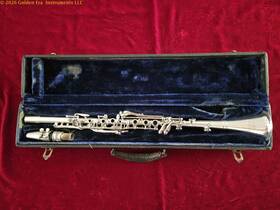
( Brand: Pan American ), ( Manufacturer Part Number: 119452 ), ( Type: Bb Soprano ), ( Body Material: Metal ), ( Color: Silver ), ( Instrument: Clarinet ), ( Key Type: Open Hole ), ( Set Includes: Case ), ( Experience Level: Intermediate ), ( Key: Bb ), ( Country Of Origin: United States )
Review PAN AMERICAN Special Metal Clarinet Circa
The **Pan American 119452 Clarinet**, circa 1940, is a finely crafted instrument that embodies the elegance and precision of mid-20th-century American clarinet design. This model, likely produced during the golden age of woodwind manufacturing, reflects the refined engineering and attention to detail characteristic of Pan American s era. Crafted primarily from high-quality **boxwood**, a material prized for its tonal warmth and durability, the clarinet features a sleek, understated aesthetic with a polished, golden lacquer finish that enhances its visual appeal while maintaining a lightweight yet sturdy construction. The **bound keys**, made from polished brass or silver-plated metal, exhibit a classic, slightly vintage patina, adding to the instrument s historical charm while ensuring smooth, responsive action. The **gold-capped keys** a hallmark of Pan American s craftsmanship provide both an elegant touch and optimal playability, reducing friction and allowing for effortless articulation.
The **barrel and mouthpiece** of this clarinet are likely original or well-matched to the era, offering a rich, resonant tone with a balanced projection that suits both classical and jazz applications. The **cork joints**, though potentially worn from decades of use, can be restored to ensure a secure, leak-free assembly, a testament to the instrument s enduring reliability. The **bell**, slightly flared and crafted with care, contributes to a full, singing tone, while the **cork-lined pads** though possibly requiring professional maintenance were originally designed to provide a consistent seal, minimizing air leakage and maximizing tonal purity. The **mechanical assembly**, including the **spring system and keywork**, reflects the precision of the time, with a focus on durability and ease of maintenance, a necessity for professional musicians who relied on their instruments daily.
Historically, the Pan American brand was synonymous with quality and innovation, and this clarinet is no exception. The **119452 model** likely falls within their mid-range series, offering a blend of affordability and performance that appealed to both amateur and semi-professional players of the era. Its construction suggests a **B clarinet**, the most common key for orchestral, concert band, and jazz applications, though variations in key or additional features like a **left-hand E-flat trigger** (common in later models) cannot be confirmed without inspection. The instrument s age also presents an opportunity for restoration, where a skilled luthier could address any wear in the corks, pads, or keys while preserving its original character whether that means maintaining a vintage patina or restoring it to a near-new condition.
For collectors and musicians alike, this Pan American clarinet holds a special place in the history of woodwind craftsmanship. Its **circa 1940 origins** place it within a period of transition in clarinet design, where manufacturers like Pan American were refining their techniques to meet the demands of an evolving musical landscape. Whether played in a symphony orchestra, a jazz combo, or a classical chamber ensemble, this clarinet carries the legacy of an era when American woodwind makers balanced tradition with innovation. With proper care and maintenance, it remains a functional and historically significant instrument, offering both a glimpse into the past and a reliable tool for modern musicians seeking a vintage sound.
### **Pros and Cons of Buying a Pan American 119452 Clarinet (Circa 1940)**
#### **Pros**
1. **Historical and Collectible Value** The Pan American 119452 is a well-regarded vintage clarinet from the early 20th century, known for its craftsmanship and association with professional players. If you appreciate or collect vintage instruments, this could appreciate in value over time, especially if it remains in good condition.
2. **Superior Craftsmanship** Early 1940s clarinets from reputable brands like Pan American were often made with high-quality materials, including fine-grained African blackwood or grenadilla wood, which can produce a rich, resonant tone. The metalwork (often silver-plated or nickel-silver) was also more durable than later mass-produced models.
3. **Distinctive Sound** Vintage clarinets, particularly those from this era, often have a warmer, more mellow tone compared to modern clarinets, which are sometimes brighter and more focused. This can be desirable for players seeking a classic, rounded sound, especially in orchestral or jazz settings.
4. **Durability** Many vintage clarinets are built to last, with solid construction that can withstand decades of use if properly maintained. The materials used in the 1940s were often more robust than those in later, cheaper models.
5. **Aesthetic Appeal** The design of early 1940s clarinets, with their ornate engravings, polished keys, and traditional finishes, can be visually striking. If you value the instrument as both a musical tool and a piece of history, this adds to its charm.
6. **Potential for Restoration** If the clarinet is in fair condition, a skilled repair technician could restore it to excellent playing order. This can be a cost-effective way to acquire a high-quality instrument without the expense of a new professional model.
7. **Connection to Musical Heritage** Playing a vintage clarinet can offer a unique connection to the musical traditions of the past. Many legendary players, including jazz and classical musicians, used instruments from this era, which could inspire your own playing.
---
#### **Cons**
1. **Condition and Wear** A clarinet from the 1940s will almost certainly show signs of age, such as worn pads, cracked or dried-out wood, corroded keys, or misaligned mechanisms. These issues may require significant repair work, which can be expensive and time-consuming.
2. **Maintenance Requirements** Vintage clarinets often require more frequent and careful maintenance than modern instruments. Wooden bodies may need periodic oiling to prevent cracking, and metal parts may corrode if not cleaned and polished regularly. The pads, in particular, may need frequent replacement.
3. **Inconsistent Playability** Even if the clarinet looks good, the intonation, response, and tone may not match modern standards. Some vintage clarinets can be difficult to play in tune, especially in the higher registers, due to the shape of the bore or the condition of the keys. This may require adjustments or a full re-keying, which can be costly.
4. **Limited Availability of Parts** Finding replacement parts for a 1940s Pan American clarinet can be challenging. While some manufacturers still produce similar components, others may be discontinued or require special ordering. This can complicate repairs and increase costs.
5. **Potential for Hidden Damage** Without a thorough inspection by a professional clarinet technician, you may not discover issues such as internal corrosion, warped keys, or a cracked body until after purchase. These problems can significantly reduce the instrument s value and playability.
6. **Resale Value Uncertainty** While some vintage clarinets appreciate in value, others depreciate if they are not in excellent condition or if the market for collectible instruments shifts. There is no guarantee that you will recoup your investment if you decide to sell it later.
7. **Learning Curve** Playing a vintage clarinet may require adjustments in technique, especially if the instrument has a different weight, balance, or response than modern clarinets. Beginners or intermediate players might find it less forgiving than a newer, more responsive instrument.
8. **Cost of Restoration** If the clarinet is in poor condition, restoring it to concert pitch may cost several hundred dollars or more, depending on the extent of the damage. This can be a significant upfront expense that detracts from the instrument s overall value.
---
### **Conclusion and Recommendation**
A Pan American 119452 clarinet from the 1940s can be an excellent investment for the right buyer particularly if you are a serious musician, a collector, or someone who appreciates the unique character of vintage instruments. Its craftsmanship, potential for a rich tone, and historical significance make it a compelling choice for those who prioritize sound and heritage over modern convenience.
However, the challenges of maintenance, potential repair costs, and the uncertainty of playability mean that this instrument is not ideal for casual players or those who prefer low-maintenance instruments. If you are considering purchasing one, **conduct a thorough inspection by a qualified clarinet technician** before buying. Ensure that the instrument is in good working order, or be prepared to budget for necessary repairs.
**Recommendation:**- **Buy if:** You are a committed player with experience maintaining vintage instruments, you value the historical and tonal qualities of a 1940s clarinet, and you are willing to invest time and money in its upkeep. It could also be a worthwhile purchase if you plan to collect or sell it in the future.
- **Avoid if:** You are a beginner or intermediate player looking for a reliable, low-maintenance instrument, or if you cannot afford the potential repair costs. In that case, a well-made modern clarinet (e.g., Buffet Crampon, Yamaha, or Selmer) may be a more practical choice.
Ultimately, the decision depends on your priorities whether you seek the unmatched character of a vintage instrument or the reliability and ease of a modern one.
Details:
We overhauled this interesting and strong-playing clarinet with all-new pads corks. $400 plus shipping. This serial number 119452 is a solid, well-built metal clarinet with silver-plated body and nickel-plated keys. While it is difficult to precisely date Pan American model's, we estimate that was made in the 1940s.
It comes with a sturdy case and an older French-made hard rubber mouthpiece. The mechanism is tight, no dents. During the early 1900s, Conn was largest maker of band instruments and manufactured several model's metal clarinets.
The Pan American Special reflected their intermediate-level metal clarinet. Please see the photographs.
part #: 119452 price
- $400.00
specifications clarinetgeariz:
- brand: Pan American
- mpn: 119452
- type: Bb Soprano
- body material: Metal
- color: Silver
- instrument: Clarinet
- key type: Open Hole
- set includes: Case
- experience level: Intermediate
- key: Bb
- country of origin: United States
general clarinetgeariz:
- Wind wood wind > Band Orchestral > Clarinets
- condition: Used
shipping clarinetgeariz:
- transit: 3-7 Days
- service: UPS Ground
- cost: $35.00
- class: Standard
- carrier: UPS
- type: Fixed
returns clarinetgeariz:
- policy: Returns Accepted
- time: 30 Days
- paid by: Buyer
- method: Money back
payments clarinetgeariz:
- credit card: Visa
- other
- wallet: Google-pay
offer clarinetgeariz:
- quantity: 1
- started: April 13, 2026
- options: Ship-to-home
- sold: 0
- availability: In Stock
seller clarinetgeariz:
- # reviews: 417
- rating: 100.0%
- city: Kennesaw, Georgia
Pan American 119452 Is Similar To:
- Pan 1920 12799 American Clarinet Zyloid (48.9% similar) The case shows sign of wear, but all the latches and locks still work. The slide lock says eagle lock co. The clarinet isn't in playing condition as it needs a little work. It has it's original leather grip case. The last picture shows a crack that had been repaired some time ago. Terrible, Conn...(February 14th, 2015)
- 150532 Soprano Clarinet Bb Mouthpiece Pan-american Vintage Sn (41.4% similar) Connection between mouthpiece and barrel is somewhat loose. Vintage Pan American bb soprano clarinet Sn w mouthpiece case condition good used condition, with scuffs, tarnish, minor oxidation, and some pitting. Cork is in decent shape, but could stand to be replaced as well. To 3/3 0 PO. Pads show ...(March 7th, 2015)
- 157658 Pan-american Clarinet Vintage Pan American (23.1% similar) ...(December 26th, 2016)
- 159231 Conn 1947 Pan American (28.6% similar) It also shows some signs of age. The case included is original one, with working latches. The mouthpiece is labeled 44, and ligature slightly tarnished. It appears that the handle was originally made of two different leather handles, one which has fallen off long ago, but still holds up. I cannot ...(April 19th, 2017)
- 162302 Conn 1948 Pan American (28.6% similar) Most of the pads seem to be in fairly good shape, but there seems some re-corking needed. Also, the barrel joint is missing also. There is no mouthpiece or ligature included. The key to play low f3 and middle of staff c5 toward top bottom joint is missing a whole pad. I cannot adjust shipping prices...(April 19th, 2017)
- 32183 Vintage Pan American Elkhart Indiana Clarinet Good Condition (46.3% similar) ...(June 25th, 2016)
- 79015 Clarinet Vtg Special pan-american Metal Mouthpiece Star (25.2% similar) ...(February 26th, 2015)
- Conn Pan-american Clarinet Usa Case 79324 Div Carrying (41.1% similar) Pan American has not been played since the 70'S. This is the first time the clarinet has been out of case since the 70'S for pictures. Conn ltd USA clarinet, w carrying case...(December 30th, 2014)
- Pan American 84n Elkhart Vintage B182448l Ind Zyloid Clarient (48.3% similar) No idea of its history. Case is rather worn with leather handle missing. Bought at a garage sale...(January 11th, 2015)
- 884n American Brilliante Conn Pan Silver-plated Metal Bb Clarinet (48.3% similar) Pads corks are excellent and the instrument is precise and playable. Comes in the original case w logo the only thing that suggests its vintage. Measures 15 l, 5/1 2 w, and d, nice and compact. Elegantly trim and tightly crafted workmanship. This is Conn's Pan American line brilliant model three ...(October 12th, 2015)
- Conn Vintage Pan-american School Student Bb Clarinet With Padded Hard Case Hs 810472029481 (42.8% similar) Perfect for the beginning student or more experienced player. I ship very quickly, usually the next day. I'm trying desperately to be rated as. This comes in its original hard case with HS France mouthpiece, and 2 screw in music holders. Just a super addition to any instrument collection, add it to ...(June 4th, 2016)